
The Best Way to Teach AI to Children Isn't What You Think
I used to think the hardest part of learning was the math—the formulas, the logic, the syntax.
Then I tried to explain a neural network to a 10-year-old.
You quickly realize the barrier isn’t intelligence. It’s language.
We try to teach the what of AI—the definitions of algorithms, data, and models—before students have any frame of reference for why these concepts matter or how they feel in the real world. We teach the lexicon before letting them experience the story.
At BiteSyllabus, we’ve learned that the best way to teach AI to children is to not teach “AI” at all—at least not at first. You teach curiosity, patterns, and consequences through stories. The technical understanding follows naturally.
Principle 1: Start with the “Why,” Not the “What”
Before a child learns the word data, they should play the role of a Data Gardener.
Before they hear bias, they should become Bias Detectives.
Look at the standard approach:
“Children, today we learn about supervised learning. It is when an algorithm maps an input to an output based on example pairs.”
Now compare that with the story-first alternative from our Grade 5 module:
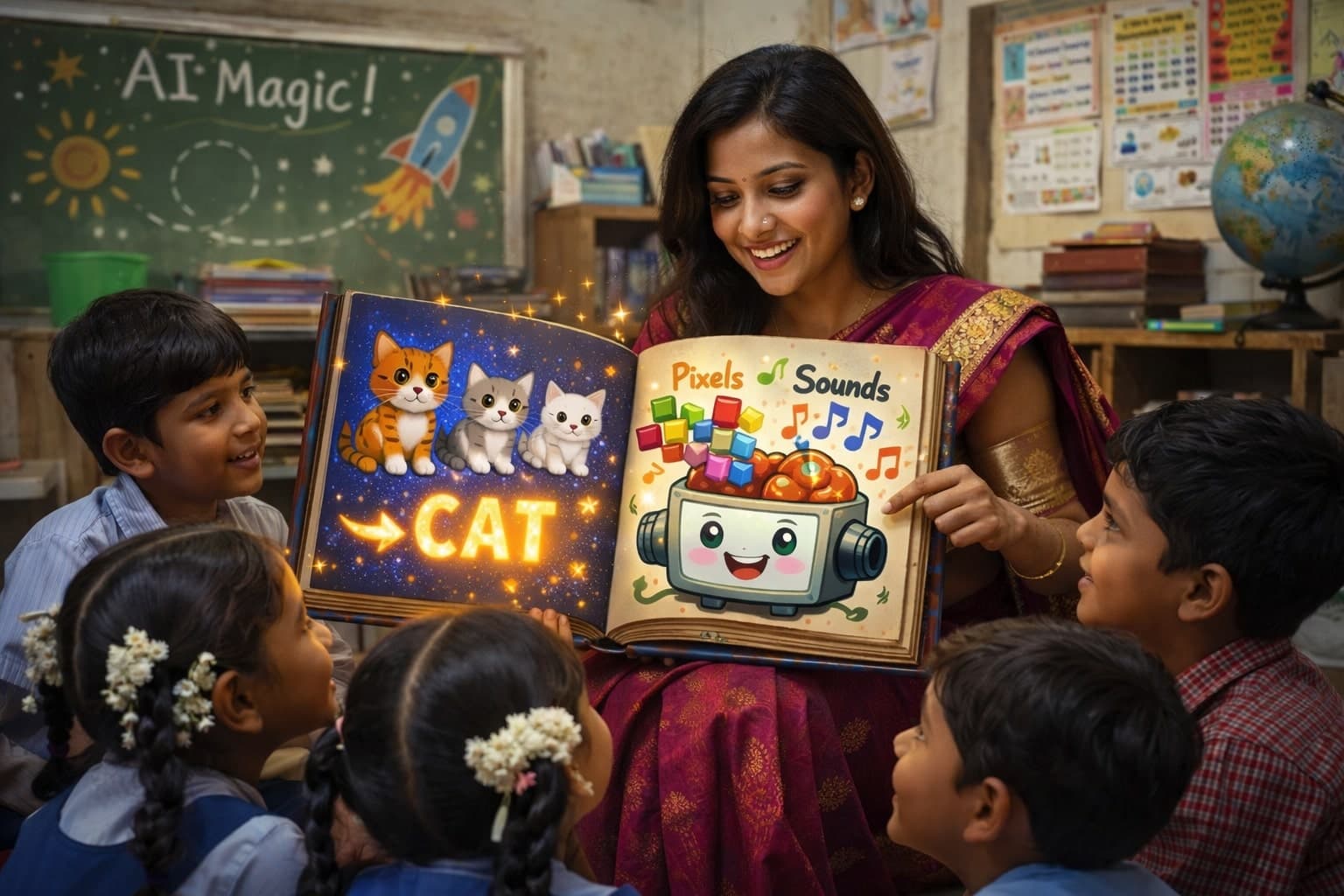
“Imagine you have a magical cookbook where the ingredients are pictures and the instructions are labels. Let’s teach this computer to be a chef that only makes one thing: recognizing cats!”
The first approach introduces a textbook term.
The second introduces a mission.
The child isn’t a passive learner; they’re a trainer, a chef, a gardener. The complex concept (supervised learning) becomes the behind-the-scenes mechanic of their own story.
Principle 2: Analogies Are the Scaffolding, Not the Decoration
An analogy isn’t just a cute entry point—it’s the entire scaffolding for understanding. It must be robust, familiar, and extendable.
In our platform, we don’t just say “AI learns from data.” We build a whole world:
- Data = Ingredients
- Labels = Instructions
- A biased AI is a hungry student who only ate pizza and now thinks all food must be pizza
- A fair AI needs a Data Gardener to plant diverse seeds and pull out bias weeds
These aren’t throwaway lines. They are the core mental models.
When a student later encounters a real-world headline about a biased algorithm, they don’t see an impenetrable tech failure. They see “Munchy the AI” who was fed only one type of data. The ethical implication isn’t a lecture—it’s a logical conclusion from their story.
Principle 3: Interaction Trumps Explanation
You can explain the theory of bias forever.
Or you can run the Bias Detective activity:
- Show 20 pictures of doctors (all men)
- Show 20 pictures of nurses (all women)
- Ask:
- “If an AI learned from this, what would it believe?”
- “Who is missing from this picture?”
The “Aha!” moment is instant.
The abstract danger of biased data becomes a tangible, discussable puzzle. The learning is in the doing and debating, not in the listening.
That’s why our modules are built with:
- Interactive activities
- Visual simulations
- Discussion prompts
—not just text.
Principle 4: The Teacher Is the Guide, Not the Source
This is where philosophy meets practice.
A teacher doesn’t need to be an AI expert. They need to be a curiosity facilitator.
This was the core insight behind building BiteInstruct. When a teacher prepares the Data Gardener lesson, they aren’t left alone with a dense textbook. Their AI guide helps them:
- Grasp the concept deeply in Tutor Mode, using Socratic questioning
- Generate the story about the confused chef who mislabels ingredients
- Instantly create classroom activities with tailored examples
The platform exists to empower the guide, providing storylines, activities, and support—so the teacher can focus on what they do best: guiding discussion, nurturing curiosity, and connecting ideas to the child’s world.
The Goal: Building Intuition Before Vocabulary
Our mission at BiteSyllabus isn’t to create a generation of child programmers.
It’s to create a generation of AI-native thinkers.
- A child who has been a Data Gardener intuitively understands why diversity in data matters
- A child who trained a cat-recognition chef understands that AI doesn’t know—it recognizes patterns we show it
This intuition is more valuable than memorizing a thousand technical terms.
The best way to teach AI to children is to embed its principles into the language of play, story, and discovery. The technical terms will come later. The critical thinking, ethical lens, and understanding of technology as a human-shaped tool must come first.
This is the path we’re building.
Not with more jargon—but with better stories.
👉 Explore our free, story-driven curriculum for Grades 1–10 to see this philosophy in action:
Explore the BiteSyllabus Curriculum